
Downspout Installation That Carries Water Safely Away
A gutter can collect every drop perfectly and the system still fails if the water has nowhere good to go. Downspouts are the drainage half of the system: they take the water gathered along your roofline and deliver it to the ground, away from your foundation, your walkways and your planting beds. Too few downspouts, downspouts that are too small, or downspouts dumping at the base of the wall are behind a surprising share of wet basements, cracked soil lines and icy sidewalks. At Gutter Experts USA, downspout installation is a core part of our gutter work in all 50 states - planned, sized and fitted with the same care we give the gutters themselves.
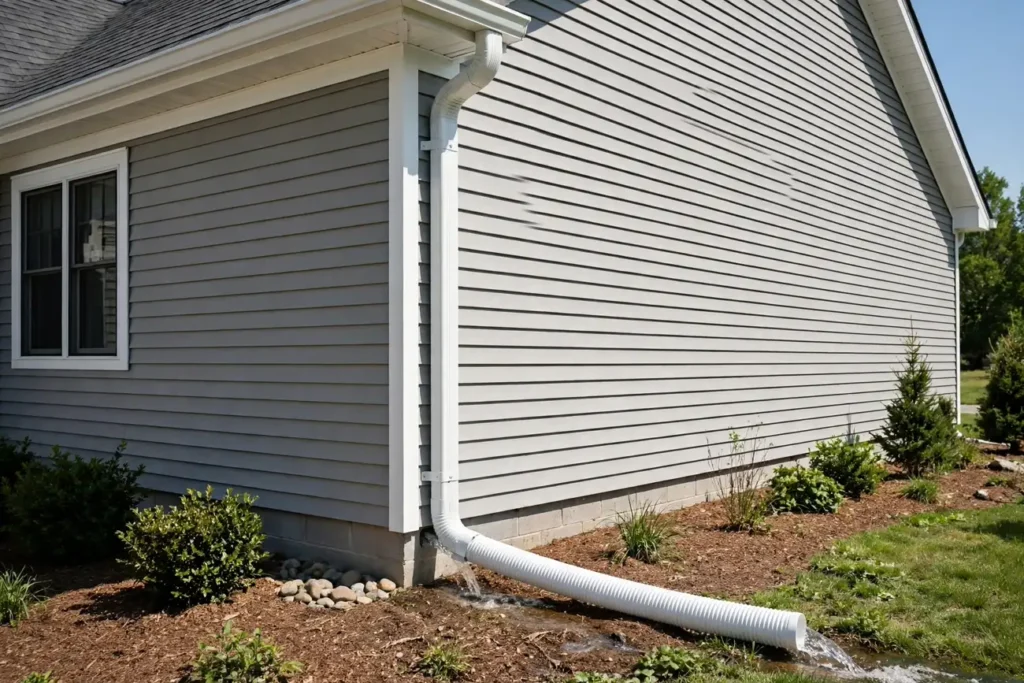
Our crews install downspouts on new systems, add them to existing gutters that have always drained poorly, and replace crushed, detached or badly placed ones. Every installation ends with a flow check, because a downspout is only as good as where its water lands.
What Our Downspout Installation Service Includes
Load calculation and placement planning
We work out how much roof area drains to each run and place downspouts where the water load and the property layout say they belong - typically at run ends, but also mid-run on long gutters, and always with a discharge point that suits your yard, driveway and beds.
Correct sizing, including oversized options
Standard downspouts suit standard roofs. Large roofs, steep pitches and 6-inch gutter systems call for oversized downspouts that move water as fast as the gutter can deliver it. We match downspout size to gutter size and roof load so nothing backs up at the outlet during a downpour.
Clean fitting and secure fastening
We cut outlets precisely into the gutter, fit elbows to bring the downspout neatly against the wall, and strap it securely at proper intervals so wind and ladders cannot work it loose. Seams are oriented to the wall, joints are sealed where needed, and the finished line runs straight and tidy.
Discharge that protects your home
The job is not finished at the bottom elbow. We fit extensions, splash blocks or drain connections that carry water several feet from your foundation and release it where it will soak in or run off harmlessly - not across your walkway to freeze, and not into the bed that washes out every spring.
Signs Your Home Needs Downspout Work
- Gutters overflow in heavy rain even though they are clean and sound
- Water pools against the foundation or the basement takes damp after storms
- Downspouts are crushed at the bottom, split, rusted or missing straps
- A long gutter run drains to a single small downspout at one end
- Water dumps beside a doorway, walkway or driveway and freezes in winter
- Mulch and soil wash out in one spot below the roofline after every storm
- Your gutter system was upgraded but the downspouts never were
How Our Downspout Installation Process Works
- Call and describe the issue. Overflow, pooling water, a damaged downspout - tell us what you see and we schedule a visit.
- Assess the whole drainage path. We inspect your gutters' size and pitch, count roof load per run, and trace where each downspout discharges today.
- Plan size and placement with you. We show you where new or larger downspouts should go and where the water will be released, and confirm the plan before work begins.
- Install and flow-test. We cut outlets, fit and strap the downspouts, finish the discharge points, and run water through the system to prove it drains end to end.
Where Downspouts Should Go - and Where They Should Not
Good placement is quiet problem-solving. A downspout belongs where the run's water load naturally collects, mounted on a wall face that lets it run straight to the ground, discharging onto ground that slopes away from the house. It does not belong dumping onto a lower roof without a plan for that added water, beside a stoop where its outflow turns to ice, or at an inside corner where two walls trap water against the foundation. On long runs, one downspout at each end, with the gutter pitched from the middle, drains far better than a single outlet straining at the far end. Corner downspouts can serve two runs at once when the design calls for it. Our crews walk your property with these rules in mind, so every outlet earns its place.
Questions about your gutters? Talk to our team now.
Downspout Sizes and Styles
Most homes use rectangular downspouts in 2x3 inch size on 5-inch gutters, stepping up to 3x4 inch on 6-inch systems and large roofs - that larger size moves roughly twice the water, and it is the single most effective cure for chronic overflow at the outlet. Round downspouts pair with half-round gutters on traditional homes. Materials match your gutters, usually aluminum in the same factory color, so the drainage system reads as one designed whole from the street. Decorative touches like rain chains suit specific spots - a covered porch corner, for instance - and our crews can advise where a chain performs well and where a closed downspout is the wiser choice for the water load involved.
Problems Proper Downspouts Help Prevent
Water management succeeds or fails at the discharge point. Downspouts that end at the foundation pour thousands of gallons a year into the soil your house stands on, contributing to basement seepage, foundation staining and soil settlement. Undersized or too-few downspouts turn clean gutters into overflowing ones, sending water over the edge onto fascia, siding and windows. Loose and leaking downspout joints spray water against the wall with every storm, quietly rotting siding and trim. Correctly sized, placed and finished downspouts move the water those few extra feet that change everything: away from the structure, onto safe ground, every single storm. The EPA guidance on moisture and mold explains why moving that water away from the structure matters.
Downspout Installation in All 50 States
Downspout design follows weather. In the Southeast and Gulf states, our crews size for sudden, intense downpours. In snow country, we strap and place downspouts to survive ice loads and spring melt. In the dry Southwest, we plan discharge so rare heavy rains do not erode the yard in an afternoon. Wherever you live, find your city on our Service Areas page and call us - we will make sure the water your roof collects ends up where it can do no harm.
Where the Water Goes After the Downspout
A downspout's job is only half done when water reaches the ground. What happens in the last few feet decides whether your foundation stays dry. The simplest finish is a splash block, which spreads the flow and keeps it from drilling a hole in the soil at the base of the wall. Hinged or fixed extensions carry water several feet out, past planting beds and onto ground that slopes away from the house. Where lawns, patios or walkways leave no good surface path, we can tie downspouts into underground drain lines that carry water to a daylight outlet or a dry well farther from the home. Each option has trade-offs: extensions are simple and visible, while buried lines are invisible but need to be planned so they can be cleaned if leaves ever get past the system.
During installation we look at your grading, your beds and your hard surfaces, then recommend the finish that moves water the full distance it needs to travel. Rain chains and decorative outlets can also serve as downspout finishes on porches and entries where looks matter as much as drainage.
Frequently Asked Questions
How many downspouts does my home need?
The standard guide is one downspout for every 20 to 30 feet of gutter, but roof size matters more than gutter length. A large roof plane delivers far more water than a small one over the same run, and valleys concentrate flow further. Our crews calculate from your roof's actual drainage area per run, which is why some homes need an added downspout in the middle of a long run and others are perfectly served by the standard spacing.
My gutters overflow only at one corner. Is that a downspout problem?
Often, yes. Overflow concentrated near a downspout usually means the outlet cannot accept water as fast as the gutter delivers it - the downspout is too small, partially blocked at an elbow, or serving too much roof. Overflow at the far end of a run more often points to pitch or capacity. During our visit we find which one you have, because the fixes are different and guessing wastes your money.
Can you add a downspout to my existing gutters?
Yes - it is one of the most common upgrades we make. We cut a new outlet into the existing run, fit the downspout against the wall with matching elbows and straps, and adjust the gutter's pitch if the new drainage point requires it. If your current downspouts are undersized, we can replace them with larger ones on the existing outlets in the same visit.
What is the difference between 2x3 and 3x4 downspouts?
The numbers are the downspout's width and depth in inches, and the step from 2x3 to 3x4 roughly doubles the water it can carry. Homes with 6-inch gutters, big roof surfaces or steep pitches generally need the larger size; standard homes on 5-inch gutters are usually well served by 2x3. There is a visible difference - 3x4 looks slightly more substantial on the wall - and in the same color it blends in cleanly.
Where should downspout water be released?
Ideally several feet from the foundation, onto ground that slopes away from the house, where it can soak in or run to a safe low point. We fit extensions or splash blocks as standard, and where your property has underground drain lines, we can tie the downspout into them. The places to avoid are right at the base of the wall, across walkways and driveways, and into planting beds that cannot take the volume.
How many downspouts does my house need?
It depends on roof area, gutter size and how your rooflines are arranged. As a rule, a run needs an outlet before it carries more water than the downspout can move, and long runs often drain better with a downspout at each end. During our visit we count the water each section of roof delivers and place downspouts to match, so no part of the system is asked to do more than it can handle.
Gutter Installation - complete systems, downspouts included
Gutter Repair - fix leaking, loose or crushed downspouts
Seamless Gutters - pair new downspouts with seamless runs
Gutter Replacement - full system renewal, drainage redesigned
Give Your Roof Water a Proper Exit
Your gutters gather the water - your downspouts decide whether it protects your home or attacks it. If yours are too few, too small, damaged or dumping in the wrong place, our crews will size, place and fit them correctly, and prove it with water running through the finished system. Call us today to schedule your visit: